Porcelain cups and saucers
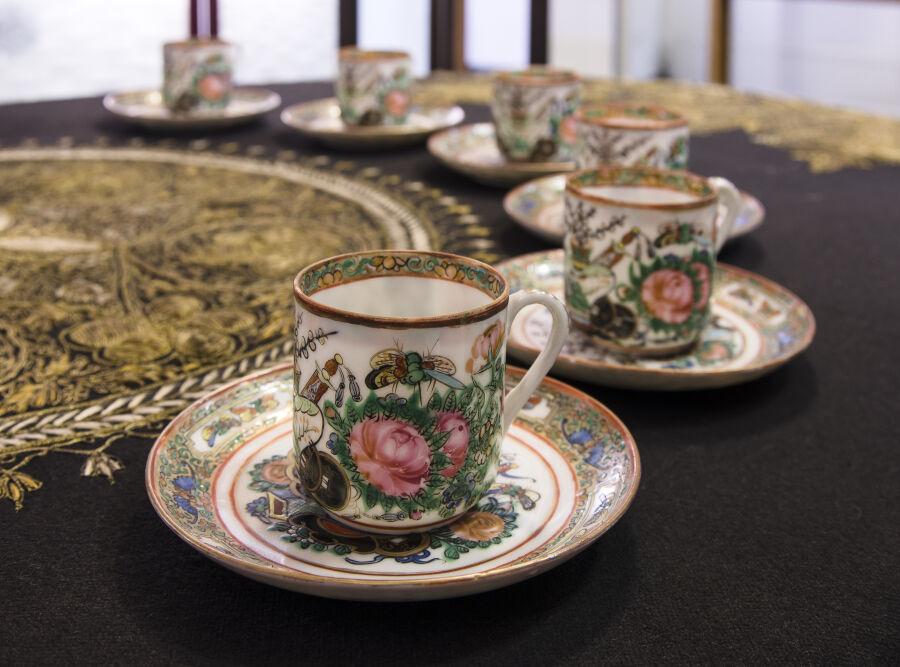
The museum started in two rooms of the Mission House around 1883, including a Chinese tea set, in which the guests of Father Arnold Janssen were sometimes served tea.
Bronze cloisonné wine Jar with Five-Toed Dragon
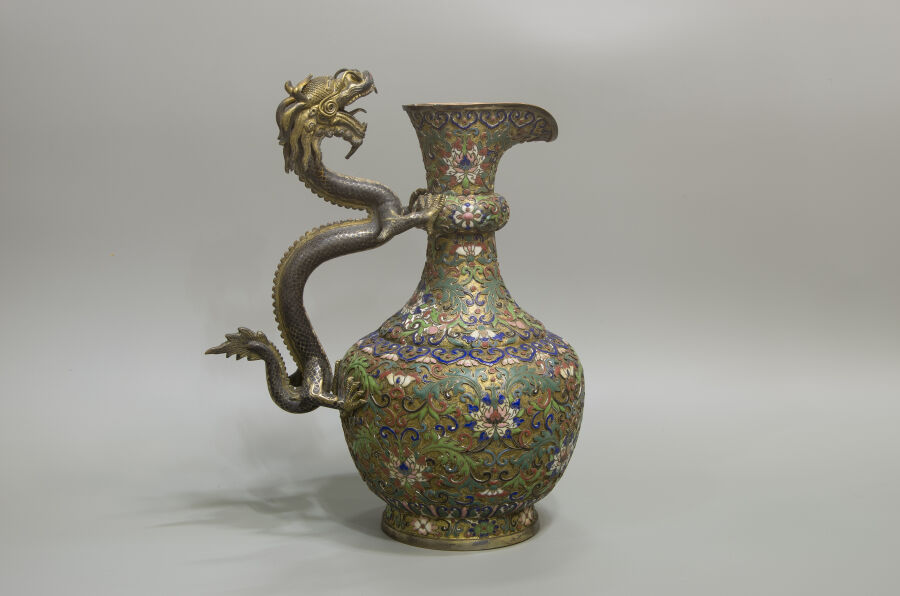
In China, dragons are the bringers of good fortune, but only an imperial dragon may have five toes. Dragons with four toes are for princes and foreign kings. For the common people, a dragon may only have three toes.
Cloisonné is an ancient technique of decorating metal objects with colored material held in place or separated by metal strips or wire, usually gold. In past centuries, vitreous enamel has been used, but in older periods, inlays of cut gemstones, glass, and other materials were also used. Cloisonné enamel objects are worked with enamel powder that is worked into a paste, which must then be fired in a kiln. If gemstones or colored glass are used, the pieces must be cut or ground to the shape of each cloison. In China and Japan, the object is then polished until no wire protrudes above the enamel. This art form was used as early as the 5th century BC and was widely used in Byzantine architecture.
From Byzantium the technique reached China in the 13-14th century, the earliest datable pieces date from the reign of the Xuande Emperor (1425-1435), but they show a full use of Chinese styles, indicating considerable experience in the technique. By the early 18th century the Kangxi Emperor had a cloisonné workshop among the many imperial factories. The most elaborate Chinese pieces are from the early Ming Dynasty, especially the reigns of the Xuande Emperor and the Jingtai Emperor (1450-1457). The Chinese industry seems to have benefited from a number of skilled Byzantine refugees fleeing the fall of Constantinople in 1453. The Chinese name for the technique, jingtailan ("Jingtai blue ware"), refers to the Jingtai Emperor. In much Chinese cloisonné, blue is usually the predominant colour.
Explanation by Father Antoon Volpert SVD from 1902
THE TSCHAN-ZE OR CARPET OF HONOR
In China it is the custom that meritorious mandarins receive certain distinctions from the people or from friends; for example large wooden tables of honor with a central motto, consisting of four gilded letters, called Biaen; or large silk umbrellas with the name of the giver on them, called Wuan-min-saen; or fine garments, covered with the names of the givers, called Wuaen-min-y; the most common, however, are the carpets of honor, which people call Tschan-ze. This gift is presented to the mandarin on promotion or at a birth celebration.
The carpet of honor sent here was presented to me on July 5, 1901 in the city of Jangkoe.
The artistic embroidery and even more the origin of this object made me decide to send the carpet to the mission museum in Steyl. Here first some historical notes. This carpet comes from the estate of the tyrant who tortured the blessed P. Perboyre. His name was Dsou-tien-ziau and he was viceroy in Hoepé. His birthplace was in the vicinity of present-day South Shantung, where he is also buried and where part of his family still lives, in the meantime very impoverished. Another branch of his family lives in Sütschou-foe, is still very wealthy and still has several members who function as mandarins.
His birth village was Dou-tja-jae. Child of poor parents; his father was a shepherd. He had to earn his own bread as a servant for strangers. When he was 18 years old, he started to study. During the day he studied hard; and the night he spent with exercises for military service. He had extraordinary talent and achieved great learning. He was appointed viceroy over two provinces and rendered good services to the State. As the martyrdom history mentions, he was very hard-hearted. He even became so gruesome that he fell into disfavour with the emperor. Dsou-tien-ziau was deposed and banished, but later the emperor used his services again. He must have fallen as a general in the war against the rebels. The State still honours him as a hero and meritorious statesman and has granted his family the privilege that one of his closest relatives may always bear the learned degree of the Djü-gen. It is strange that the best statesmen of China are precisely the greatest enemies of foreigners. In these extraordinary people, Chinese patriotism is anchored and with it the hatred of foreigners.
EXPLANATION OF THE FIGURES
In the middle of the carpet is depicted a great mandarin in ancient dress. In his right hand he holds a sceptre, as a sign of his dignity; his left hand curls the point of his three-part transparent beard. (It is not the portrait of the one who is celebrating). Above this main figure, three figures can be discovered: on the left a mandarin, symbol of his official dignity; on the right a man with a child, the symbol of wealth and family happiness; in the middle a spiritualized old man with a peach, the symbol of a long life. According to a Chinese legend, these three figures are three stars that have been transformed into divine beings. In these three are anchored the main wishes of the Chinese: Fu, Lu, Schou, that is happiness, official dignity and great age. At the top you see a dragon with a plate in its mouth, on which four signs are depicted, which indicate that by special favor of the emperor and the empress mother, the veneration of the celebrant followed. On both sides of the dragon are colorful birds. This bird is the fabulous Fung-chuang, which according to legend was always visible in the golden age, then disappeared from the earth and only showed itself again when the people lived in happiness and peace under a perfect ruler, it is therefore presented as a symbol of peaceful popular happiness.
Below the dragon you see the sun; the sun of happiness shines briefly above the venerated one. Around the main figures in the frame you will find 8 figures with different distinctions depicted; they are the well-known Ba-sien, 8 people, who through striving for perfection obtained the gift of immortality and who still appear today to provide miraculous help to mortals. Each figure has a special meaning according to pagan legend. Below you see a palace of Fung-chuang and bats (the latter is the symbol of imperishable old age). Below that 3 lions. The whole, despite the splendor of colors, makes a dark, sad impression on us; it is therefore a representation of superstitious figures, of which the dragon and the old snake are at the top, which keep the poor Chinese people in such tight chains
The letters have been removed from the carpet; in the meantime, traces of this can still be recognized, which indicate that the Eren carpet was donated by friends of the grand mandarin Dsou-tien-ziau on the occasion of his enthronement.
The blessed P. Perboyre died a martyr's death under the hands of this man on 11 September 1840.
Tsining, 2 February 1902
P. Antoon Volpert SVD.
Missionary